Rook Writes About Starting A Holding For About 4000 Words

Hey! We’re veering off hard and talking about leadership and organization stuff.  Don’t worry, there’s battle gaming articles in the works, I still have more things to talk about with wizard, and I’ve been playing a lot of another caster class that I’m DYING to spill some ink on. I want to keep my mostly informative but still fairly opinionated battle gaming content away from my PURELY OPINION DRIVEN EDITORIALIZING DRIVEL so these posts are going to be known by…  Something else. I’ll figure it out. Promise. (Taking suggestions).  They’re not a proper Babble, they’re just an essay about the game. So if you’re here for educational content that actually has a basis in objective, rulebook written fact- this article isn’t for you.  If you want to hear my musings on a subject that I’ve gotten fairly familiar with over the past year or so, read on. This is also definitely not as refined as some of my Babbles, because there’s a LOT to say on this topic and I don’t exactly need to fact check it because…

This is just sorta like…My opinion man….

Cool?  Cool.

You know what’s awesome?  Whacky bats.  You know what’s a lot less awesome?  Moving.  Moving sucks. In the summer of 2021, I had to leave my comfy home of Eugene, Oregon and my home Amtgard holding of Iron Keep in order to attend college.  This put me in a precarious spot for LARPing, because my nearest non-defunct Amtgard park became Silvermoon, nearly an hour’s drive away. And on top of that, not long after my car got wrecked and we were forced to take on a far less reliable vehicle. So I was basically dormant at the end of lockdown, not really able to get out and wack nerds or craft much. Needless to say, this was not good for my mental. 

Enter my good friend and co-conspirator Toast, who promised to come up at least twice a month if I filed off the paperwork to create an Amtgard freehold.  Then, when he got impatient and filed it for me because I was frankly too much of a sad sack to do it myself, he kept to his promise, and as such the fledgling Freehold of Satyr’s Hollow was born. Helping run this park over the past year has been an honor, a privilege, and an insane learning experience.  Within a year, our holding has attained barony status and attracted a solid playerbase of both noobs and previously disenfranchised veterans who were stuck in limbo like myself.  At the risk of sounding like I’m taking too much credit for the success of this park (which, unfortunately is just going to be a theme here.), I wanted to outline a few things that worked for us when we were starting out and trying to grow in the hopes that it might help someone else looking to start or grow a holding.  This is by no means a definitive guide, nor am I willing to guarantee the principles laid out here are what’s led to our modest success. Some of this stuff might even seem painfully obvious. But I like to think there’s something I’ve learned here that might be useful to someone. 

Satyr’s Hollow – Day 1 10/8/2022

You’re Going to Start Small

Right before we got our freehold contract, we were holding little fighter practices in a public park for fun.  These fighter practices consisted of me, my partner, and two guys I met almost by pure coincidence that were interested in doing LARP, only one of which had prior european LARP experience (shoutout to Fyord).  Toast is going to laugh at me because I was horribly unmotivated to do this until stuff really started to fall into place, but it’s probably safe to say that nearly 99% of Amtgard parks start off with a handful of friends whacking each other in a public park. The important thing is consistency.  Be there every week, rain or shine.  It doesn’t have to be for the same amount of time, but it’s important that somebody is holding down the park.  When we were still only five or six people, if I was out of town at an event or busy with school we had two remarkable individuals who kept coming out and fighting each other. Partially so they could get their weekly sparring in, but I think it’s part of what cemented us as a consistent, weekly thing.

Reach Out

Is anyone else you know stuck in LARP Limbo where you’re at, too far from the nearest park and too lazy to start their own park too?  Reach out.  It’s really that simple.  If you know people close by, reach out and drag them to your park.  Kicking and screaming if you have to.  They’ll thank you for it later, promise.  Or they’ll jump right onto it and become one of your most consistent players.

Plug Yourself

So we made a post to a local subreddit in May of last year, and it netted us like 5 people. And those 5 people brought in another 10 people.  And every now and again that Reddit post still brings in a curious (or bored senseless) soul. I browse the Corvallis and Oregon State University subreddit regularly and make comments on appropriate posts when tasteful. We also put on a big event every year called BATTLE OF THE BONES which we try to plug wherever possible and specifically design to be something people can just walk onto with little to no knowledge. A lot of these tools are free, they just require a little bit of tech savvy and some patience/persistence.

Get Some Loaners

The most common thread you’re going to find in all this is that one of the keys to success in recruiting new players to come do this crazy thing that’s going to eat up a prime weekend time slot is that you need to try to lower the barrier to entry as much as humanly possible. There’s a lot in the way of getting out to park, and while you’ll occasionally get a new player who’s 100% on board from the get go, sometimes people need a little more nudging. One of the main selling points that I get to give bored people in Corvallis is that this is a free weekend event that only requires you bring a fighting spirit, clothes you’re comfortable exercising in, and water (and even then we usually have water on hand). “Loaners” shouldn’t just mean shortswords and daggers too, if you can help it. We have the amazing benefit of having loaner shields, loaner spears (only permitted to be used after we can trust the person not to swing for the fences with it), loaner spellballs, a tiny scrap of loaner leather armor, and even a loaner bow/some arrows.  This stuff is all communal, and we basically let people use it on a first come first served basis until they feel like they’re ready to make/purchase their own stuff.  Loaner garb and sashes are also a must. Loaners should ideally serve to give new players a vertical slice of the game and encourage them to experiment a little bit with different playstyles. It also means that if you get a new player who’s less immediately interested in going at someone with a shortsword and maybe a little more keen on say- shooting a bow you can almost immediately hook them with that.  Oh, and bonus points if your park gear includes a few really basic things for running battle games. Objectives, cones and the like.

Give Out Swag

Don’t be afraid to send loaners home with people.  By week four or five you should ideally be giving someone a piece of equipment to take home. Either to keep, or on a long term loan. This almost guarantees some level of attrition for your loaners, but having a physical piece of equipment reminding you about the foam sword fighting people that meet up every weekend can help with player retention. Again, this is a bit of a risky play.  I never give away something I’m not okay with never ever seeing again. I gave out a healer sash my partner sewed me real quick on the first day we had “proper” park and I’ve yet to see that player again, much to my partner’s frustration. We were lucky enough to run a promotion for some time that saw every player that signed in five times get a free shortsword provided by the kingdom, and later by Toast, and that very much got people excited and invested. People were SO jazzed to have me stamp their little cards.  Again, this is very much a “funds and resources willing” bit of advice, but if we can hack it you might find a way to as well.

If You Can, Feed People

My co-conspirator Toast has a medical condition that means he needs to make sure to eat.  Frankly, I could be doing a better job in remembering to eat before Amtgard. When we first started off, and Toast was coming up he calculated that it’d be far, far cheaper to bring some hot dogs or something to grill than it would be to eat out regularly. So began a tradition at our park, that we usually bring an excess of food for people to snack on between games. I honestly could personally do a better job of contributing, but if you can grill up some glizzies and slam them at people it’s one less thing they have to worry about doing before showing up to park on the weekend.  And, the promise of free food has been enough to tip people over the fence into coming to check us out.  Obviously this and loaners are a little contingent on having money around, but if you have the means you should very much consider doing both.

Let The Kids Play (Or, How I Learned to Stop Worrying and Appreciate the Munchkins)

Holy crap does opening the field up to kids get you places. We recruited a veritable pillar of our community through his son who saw us playing in the park one day and informed him that there was Amtgard nearby.  Not only does letting younger kids take the field with their parents permission and a waiver net you a bunch of really passionate, young players but it frees their Amtgarder parents up to come out more. Our murder children are the best, and they’ve been doing a great job of learning the rules from the adults.  Not only that, but noobie kids often bring their parents with them and can sometimes be a consistent part of your park outright.  I know that hanging out with a bunch of kids while you do your HIGH INTENSITY FOAM COMBAT SPORT might make you feel like a bit of a dweeb, and there’s definitely pitfalls and risks, but seriously. If you get passionate, younger players to show up, give them a chance to take the field and be patient with them, you might have a new die hard LARPer in the making. Also, some of the kids are phenomenal recruitment tools. You have no idea how many people we’ve gotten to give us a spin because they stopped to watch us and my page bounded up to them to give them a sales pitch. It’s Scald’s game folks, we’re just playing it.

Run Some Militia Games (Other Than Ditch)

Ugh.  Okay.  So to say I have a complicated relationship with militia is a bit of an understatement.  I like playing Belegarth as well as Amtgard, and Bel has a more contact heavy ruleset and permits bows and armor in what’s considered the primary game mode. 6 points armor wearers are always who I focus on in militia games though.  On a particularly noobie heavy day, it’s really useful to not throw class gaming at people right away.  Your mileage may vary though, some of our newer players have taken to the V8 and even the V9 ruleset like ducks to water.  But for your average joe, having a warm up game for 10 minutes where you play Ring the Bell or King of the Hill in Militia lets them get to grips with the core ideas of Amtgard combat, fighting as a group, and learning to recognize when you’ve been hit. You know, the sort of stuff that veterans might take for granted.

If Need Be, Lower Your Power Level

One of the things I had to promise myself when we started having battlegames at park was that I was strictly forbidden from playing Wizard. I know.  What a sacrifice. And like, the unfortunate truth is that I’m maybe a A- to B+ Wizard on a good day, and a C- to C tier stick fighter on a good day as well.  But still, I’ve been doing this for close to six years now at time of writing, and I’ve faced noobs who right off the bat vary wildly in skill level. Sometimes, in the interest of keeping someone engaged and in the spirit of good sportsmanship it’s important to not go as hard as you normally would.  Fight with your non-dominant hand, try a different loadout, play a class you don’t really know super well, run a meme spell list. Not only does this make sure that Joe Shmoe walking up to you at the local park to swing stick doesn’t get intimidated but it encourages you to maybe open up and try new things. I’ve been REALLY into playing Healer lately (That’s likely what the next Babble is going to be about, for those of you invested in such a thing.) and I likely would’ve never picked up the class had I not needed something to level alongside the newer players.  And now some of my noobs who were completely fresh to LARP last year are taking over kingdom level quests because they’re such good little objective fiends, and can actually hold their own in a kingdom level battle game.  Sometimes, a newer player will need to hit the wall and will walk away with a passionate desire to “git gud”, and that’s a wonderful thing. But sometimes they just hit the wall and walk away, and it’s your job as a park leadership to limit that as much as possible.

Be an Inclusive Space

I feel like this is kind of goofy to say, but don’t be a group of elitist nerds. Be welcoming, be friendly, and at the risk of introducing dreaded politics in my silly little LARP essay: Don’t be a bigot, and handle bigots as soon as they out themselves. Welcoming nerd spaces are rare to find and a major appeal of a local LARP group can just be a welcoming, inclusive third space to hang out with other people and not feel judged. I think my proudest accomplishment with all of this is that for the time being, our holding is a very welcoming space where people seem to feel safe, and I think that is so cool.

Facebook Sucks

In the Cyberpunk Future Year of 2024 there is no reason for you to JUST have a Facebook page for your LARP. Hell, there’s less and less reason to HAVE a Facebook page for your LARP. Our main means of communication is our Discord server, which we link to with our handy dandy business cards designed by my impeccable Person-at-Arms Wicke Kellinglo. Not only is Discord a lot easier to organize, but it promotes your people interacting with each other in real time throughout the week. We do keep a Facebook page up, and it helps for discoverability but it mostly serves to point people towards our Discord.  Ditch the FB page, make a Discord.  Stick with the times for when Discord becomes too bloated and we all have to move someplace else.

Bend the Rules

Okay okay okay.  Don’t get mad at me.  And don’t narc. Just hear me out. I’m risking my Paragon and Walker cred for budging on this one. Some of the rules as written for Amtgard and some of our social norms suck. Not only do they suck, but they increase the barrier to entry for playing the game for little to no good reason.  At Satyr’s Hollow, if you’re a newer player you can expect the following:

  • Look the Part even if you’re not wearing garb.  (After a few months, I might bully someone by taking away their Look the Part until they make a tabard or something but we’ve yet to have that happen! People make garb on their own timeline.)  Being low level sucks, and giving people that extra point of magic or extra ability is oftentimes what lets them have fun and tide them over until they play for the ELEVEN WEEKS required to hit level 3.
  • Any credits from your first like…  Six or seven park days can be transferred over to another class if you don’t like the class we saddled you with on day one.  Let people play around a little and find what they like, then move their credits into it.  Don’t force someone to start from level 1 all over again when they find the class they actually enjoy.
  • We don’t really use spellstrips.  They’re finicky, and annoying, and noobs don’t benefit from them anyway. One less loaner to worry about.

That is about it, promise.  Provided you’re not in FLAGRANT breach of the CoC or rulebook, and anything you do locally doesn’t ruin your noobs for KLEs and larger events, I think you’re good to fudge a few things to improve the new player experience. At least until V9 does away with spellstrips and Look the Part as it exists entirely. Also you know, don’t get rid of rules that are there for safety?  Just keep an eye out for what rules might cause friction with newer players and see about selectively looking the other way.

Mentor People

So like, I’ve had my red belt for a little while now.  And for the longest time I didn’t really think I’d have any underbelts.  But these noobs man.  I have two At-Arms and a Page now, and they’re all utterly remarkable people who’s drive and skill sets and just sheer passion make me wish I was a more impressive player to be belted under. Mentorship comes in many forms obviously, but keep an eye out for what your new players take to and offer to link them up with people who know how to do that stuff.  Goes for fighting, battlegaming, A&S, service, WHATEVER.  And if you gel with someone, just give them the belt.  They can always move later if there’s a better fit elsewhere. Or don’t, I won’t tell you how to run your belted line.

Location, Location, Location

So I usually don’t show these to anyone else before I publish them, but I figured I’d be remiss to not show this article to Toast before I post it. He’s the reason why I’m a lot less swear-ey here than in some of my other articles, and one of the things he brought up is that having a really good park/meeting place is very important to having a successful holding. A good park/meeting place can make a good park great, and conversely a bad park/meeting place can make an otherwise good park struggle. I poked him a little more and got the following points on what makes a park good.

  • Good access to bathrooms.
  • Is it accessible? Is there enough parking?
  • Is it a public park? Do local ordinances allow you to use bows?
  • If it isn’t a public park, are the park owners cool with 10-20 nerds running all over the grass and tearing it up regularly?
  • If you live in a place like Oregon, like me, you might want to check for good drainage for when it gets rainy.
  • Is it a safe place to leave your gear?

There’s probably more, but these are good questions to ask yourself when screening potential meeting places for your holding.  It should also be noted that depending on your corpora, there’s nothing really saying that you need to meetups in a public space. If you have land that you can make accessible for wacky bats?  That’s probably a strong contender.

Adopt a “Local Level First” Mindset

In Blackspire at least, we have at least one KLE a month somewhere in Oregon or Washington.  This is awesome, we’re very close together and as such the entire kingdom feels like a coherent whole. But it can be rough for your recruitment capabilities. If everyones gone for a given weekend, any walk-ons or new people looking to come out for that weekend are in for disappointment when they learn that their local group is actually 2 hours north at some kingdom thing. I have visited other kingdoms only to find that nobody is actually meeting up at the weekly local meeting, they’re all 3 hours north at someone’s birthday party. As such, I recommend sending your populace out to KLEs sparingly and ensuring that there’s always some people looking to stay behind and hold down the fort. Recently, we had a number of people go to a local KLE, but we still managed to pull a modest weekend attendance.  Stuff like that helps you catch people who might otherwise not turn up, and helps you keep people who aren’t quite ready to drive a bunch for this weird hobby they picked up but are still down to driving 20 minutes for it in the fold.

There’s Going to be Turnover

The grim truth at the bottom of all of this.  You’re going to lose people. Truth be told? You’re going to lose a LOT of people. You’re going to lose people because they move away. Two of our founding members? Same dudes I talked about doing our first practices with?  They’re gone now.  As are a number of people who showed up for 5, 6, hell even 10 or so different park days. And we don’t lose them on bad terms.  Sometimes it’s life, or maybe they just get bored. The trick is to not let it discourage you, and keep the door open in case they want to or are suddenly able to come back.  Low barrier to entry doesn’t just net you a bunch of new players, it lets the old ones slot right back in easily. Keep moving forward, and remember the players that wind up leaving for their contributions to your park! Most everyone who comes out regularly is going to leave some sort of lasting impact, and I think that’s worth celebrating.

You Cannot Do This Alone

Alright this is where I get really corny. Satyr’s Hollow would not be doing nearly as well as it is right now if it weren’t for the fact that we were incredibly fortunate to secure some absolutely phenomenal players who are consistent, skilled, and just altogether fun to be around. I think there’s this nasty habit in Amtgard leadership where we attribute titles and awards to one person who “did a leadership”, but the fact of the matter is that a holder really is only as good as the people they’re working with. And hooo boy do I have some people to work with.  I’m honestly still a little dumbfounded that I can delegate, or even just straight up miss something and someone else at my park or in my leadership team is able to pick up the slack.  Watch for the talented people who turn up to your park.  Hell, watch for the passionate people who just want to be helpful. They are your lifeline. A holding should ultimately strive not just to be a place to play a game, but a community that’s able to support itself and its members. Oh and award them.  Responsibly, of course. 

Oh Geez Here’s Rapid Fire Miscellaneous Stuff

  • Yes, Barbarian and Monk are good classes for beginners.  But so is Scout.  Assassin can be a little complicated but lots of newer players LOVE playing it.  A forcebolt wizard list with a shortsword is also a lot of fun at low levels.
  • As much as I personally really do not care for monster, monsters are really good for people’s first day/week/month.  Slap ‘em with a mask and make them into skeletons.
  • Pressure your noobs to spellcast! If they seem like they have the head for it, nothing is going to get them familiar with the rules faster than dipping their toes into a casting class.
  • Pink sash (five foot call dead) is a godsend for accessibility. You just plain get people who normally wouldn’t play to play, and it’s really not that hard to implement.
  • If you can afford them, get a bunch of business cards. Disperse them through your park.  Give them out to weirdos in your day to day life. 
  • Play nice with the city! Try to do community outreach if you can.
  • Try to submit for your contract early.  Ours took several months and had several hidden snags between us and freehold status, but I’ve heard of other contracts being approved in mere weeks.  It honestly seems like a bit of a crapshoot.
  • Try to be a welcoming place for non-combatants.  We have a sizable noncom population at our park and they’re vital to keeping things running.
  • If you can, get your new players to a KLE within their first three months of playing, and get them to a campout within their first six months of playing.
  • Make sure your chancellor/land level PM equivalent enters attendance promptly. New players are excited to level up.

I think that’s about it. Thank you for reading all that! I’ll probably be writing a few more of these opinion pieces in the near future, so if you for whatever reason are invested in my hot LARP takes, stay tuned. Otherwise, I hope some of you found this article informative. Now go forth and spread the joy of whacks!

Satyr’s Hollow – Elevation to Barony Status 12/16/2023

Babbling Rook #5 – Realm of Enchantment

I’m counting this as two Babbles in one year, and you can’t stop me. This one is over twice the length of anything I’ve done before, so if we really want we can count it as three.

Enchantments are a really important thing in Amtgard. Unless you’re playing Barbarian, just about any class can benefit from finding the right person to give them the right thing at the right time. Warriors get to stomp around with their Ancestral Armor and Phoenix Tears.  Druids terrorize the battlefield with magic armor, wounds kill weapons, and immunities that make them trickier to deal with. If you’re playing a class that can take enchantments, and your team is running them, there’s not much reason to not seek them out in most battlefield settings. However, as a new player (or a new Wizard) may note.  There’s a LOT of enchantments.  Around 41 which can be taken and given to other players by my count (Though I’m sure I totally missed one or two, and somebody is going to loudly remind me about which one I missed.) Some of these enchantments synergize so well with most Wizard playstyles that if offered you should always take them. Others have niche uses on certain fields or battlegame types, and some are just…  Just bad.  Very bad.  Or don’t really affect Wizard, even if there’s nothing saying we can’t wear them.  

So to that end, I wanted to put together a little guide on what enchantments a Wizard should be utilizing on the field, who to seek out for them, and some general tips and tricks for getting the most out of them. Because I like being contentious and encouraging people to yell at me about how bad my takes are floods my cold, dead heart with joy- I’ve decided to format this article as a tier list so you can see what enchantments I think are objectively terrible on Wizard, and which ones I think are actually just sort of okay. So without further ado, I want to define some tiers.

S Tier – Objectively a phenomenal choice.  Cream of the crop.  Basically worth considering taking in any situation if someone is offering it to you. 

A Tier – Workable, strong enchantments that meaningfully contribute to the Wizard playstyle but otherwise aren’t as synergistic as the options in S tier.  Still really good.

B Tier – Usable enchantments that either don’t work well with Wizard’s kit, have really niche applications or just have better alternatives. Usually best taken for meme potential or to catch somebody off guard.

C Tier – Enchantments that are an active hindrance to playing Wizard and don’t synergize well with their kit, or sometimes even any kit. Sometimes these spells are just bad on rate. You might not even see people take these on the field.

Oh, and I’ll be starting from the bottom up.  Because these enchantments get cooler to talk about the further up the list you go.

NULL TIER –

Except I lied.  Here’s the tier for enchantments that don’t do ANYTHING for a Wizard.

Alright, really.  This is just a list.  A short one. There’s not really much else to say.

Imbued Armor, Ancestral Armor.


The class that can’t use armor in any way doesn’t benefit from the enchantments that affect Armor.  Shocker.

C Tier – 

Contagion – Interesting enchantment.  A budget Imbue Weapon on Wizard that makes you fragile.  This is very bad to receive as a Wizard, and frankly pretty bad on rate on anyone other than maybe a Warrior.  I’d love to see them look into reworking this into something actually fun and useful.

Gift of Earth – Just about anything that makes you suppressed basically is an auto-include to this part of the list.  Gift of Earth is such an underwhelming enchantment that barely anybody takes it though. Two points of magic, non-ancestral armor, and a Greater Harden is pretty lame. Especially for a Druid enchantment.

Gift of Fire – Also sucks.  Immunity to Flame is nice, but how often are you really catching another Wizard’s Lightning Bolts and Fireballs? Otherwise, you’re making yourself less susceptible to a Druid’s Call Lightning and people casting Heat Weapon at you. Not worth it for you, not worth it for the Druid.  Even if it gives you a per refresh, rechargeable, Heat Weapon. Again, very lame, especially from Druid.

Gift of Water – It’s Great Value Brand Regeneration.  Or Trollsblood.  It’s a point of armor and an unlimited self only heal. Of the four Gifts Druid has, I call this one the least egregious of the “bad” ones (We’ll get to the good one later, don’t you worry.) I actually think this spell might see more niche use if they removed the self restriction on the heal. It still wouldn’t be great but letting certain types of backline classes have a heal to use on other people might be fun. As it stands though, I believe the main use for this spell is to give it to your teams Archers in order to make them slightly better at dueling other Archers. For Wizards though, it’s C tier.

Corrosive Mist – For the low low cost of being stopped and not being able to take another enchantment, you can cast 5 uses of Destroy Armor on a specific hit location using a special incantation that feels clunkier than just casting Destroy Armor at them. Underwhelming Druid Enchant #4.

Essence Graft – “But Rook!”  I hear you cry.  “Essence Graft is awesome!  You get to wear THREE Enchantments.”  Yes, yes you do.  Essence Graft is awesome.  But it’s way, WAY more impactful on somebody other than a Wizard.  You could, hypothetically, slap every enchantment in S tier onto one Wizard and turn them loose to dominate the field.  But you’re far, far more likely to instantly eat a Naturalize Magic or a Dispel Magic and lose the entire stack.  Stacking enchantments is fun, but it can also very much a “win more” sort of tactic, and without a Golem making everything persistent, one death and you’re wasting a great deal of resources. Golem/Essence Graft would probably be better if Druids weren’t able to give eachother Golem and ride off eachother as spawn points. If you really want my ideal Wizard Essence Graft enchantment stack, for the way I play it would look something like this:

Protection from Magic  -> Essence Graft (Order matters here, as Essence Graft means you can only receive enchantments from Druids.) -> Gift of Air -> Ironskin -> Sleight of Mind

This is a lot to throw on one player, especially considering just one of these enchantments is potent when utilized in its own right.  Furthermore, there are just better classes for stacking enchantments on. Druids cast Golem on each other for a reason. As such, I put this in C Tier, though if you’re really the only person that your Summoner buddy wants to throw stuff onto, I could bump it up to B tier.

Bear Strength – Not as good as Poison, rarely ran by Druids.  Better on someone who can get up close and fight in a shield line.  It should be noted that starting at level 4 with the addition of Fireball to your kit, a Wizard has far, far better options for dealing with shields than Bear Strength.

Flame Blade – Alright, for a moment, I’d like you to imagine my explanation for why the Flame Immunity on Gift of Fire isn’t very good.  Then, I want you to wedge that onto the end of my previous explanation of Bear Strength. Then, I want to casually remind you that Wizards have way better ways of dealing with armored classes than becoming a diet Barbarian who can’t wear armor and can’t Fight After Death.  Better on a Druid, or an Anti-Paladin.  Or someone who can seriously throw down against armor.

Blessing Against Harm/Ward Self/Blessed Aura – Ugh.  Ok, so these three are basically the same spell.  Ward Self is Blessing Against Harm for Wizards and self only. Blessed Aura is Blessing Against Harm, but it can stop something that affects equipment, like a Fireball or Pyrotechnics.  I hate these spells because there are very few middle-ground results in casting them. You either get phenomenally lucky and use it to eat a Finger of Death, a Sphere of Annihilation, or an Abeyance. Or, it stops the first schmuck to run up and take your arm off and die immediately after. Feast or famine, in the most abject sense. There’s a world where this suite of spells doesn’t totally suck, but as it is I find them incredibly niche in spite of their potential to be an absolute blowout in terms of exchanging resources.

B Tier – 

Harden and Greater Harden – Not useless, as they allow you to use your equipment to block arrows. But there are far better options.  Take this if your team really has nothing else to offer you, but that’s pretty unlikely.

Barksin – Point of magic armor on all five hit locations!  Yay!  It’s not Ancestral Armor, so you’re still weak to spellballs! Boo!  It’s dirt cheap and still blocks Arrows! Yay! Worth taking it if offered. But there’s stronger, better alternatives that most Druids are willing to give out.

Poison – Surprise, surprise.  Killing someone by taking their arm or leg is pretty good.  Poison, is pretty good.  Wizards aren’t the best at getting up close and killing someone with poison, that’s more of a Druid or Assassin shtick. But all and all, making your weapon slightly more dangerous at the low cost of a per life enchantment from a Druid?  Probably pretty worthwhile.

Regeneration – Swift Heal (Unlimited) are three pretty spicy words.  The ability to bring a limb back with the only caveat being you need to stay 10 feet away from an enemy player makes you really good at pulling back and putting yourself back together if the need arises.  That being said, and I might be confessing to a bonafide Skill Issue™ here.  Wizards don’t get wounded on their own very often. If you’re playing a Wizard that goes deep into a backline to try to tear stuff up with a short and spellballs with Teleport.  A single wound is the least of your worries. In a more team oriented strategy, odds are pretty good your teams Healer(s) are going to be nearby to patch you up anyway, so I’d save this one for other classes. 

Lycanthropy – I almost want to be a contrarian and put this one in A tier, and maybe if Paladin and Anti-Paladin weren’t such massive players constricting the lifeforce out of every Bard player in the game right now I would. For a 4th level Druid Spell, Lycanthropy gives you 2 points of magical, non ancestral armor, shield crushing melee weapons, and immunity to Command.  Back when I first started playing, before Barbarian received its buffs and Paladin and Anti-Paladin were knights only classes, Lycanthropy was a premium answer to Bards being utter nuisances with Awe and Lost. It’s a bit of a weird enchantment, and I’ll be the first to admit to overestimating it when I played it as a Healer last event I went to- but I think it’s something you could run on a Wizard. The shield crushing should basically be considered bonus, as again we have far better ways of dealing with shields (Though notably not on a Battlemage build), so I would consider this almost like a slightly weaker Ironskin for our purposes, providing the same amount of armor, albeit non ancestral, and giving a more relevant immunity to Command rather than an immunity to Flame. 

Poison Glands – Stands to reason that if Poison is B tier, Poison on a Stick™ might make it to A tier, but this is what I’d consider high B Tier.  Poison is nice.  More poison is more nice.  But not enough for me to actually recommend seeking it out unless you really want to lean hard into playing sword wizard.

Imbue Weapon – Again, sort of the same deal as Poison and Poison Glands. Useful if you want to lean hard into the sword wizard playstyle, but otherwise there’s far better options. Especially for a 6th level spell.

Undead Minion/Greater Undead Minion – Alright, I’m going to try to keep this one brief in spite of these being kind of bastard enchantments that are really, really complicated and can make people really confused and angry sometimes.  You’re Suppressed, you’re Fragile (At least, on UM. GUM removes this caveat, and that’s basically the only difference.) and you’re Cursed.  When you die, you go Insubstantial instead of dying as per normal, and can be revived by the person who Undead Minion’d you at a rate that’s usually faster than your average death count. Only way to kill you for good is to either kill the person you return to, remove your Insubstantial state while its active with something like Tracking or Planar Grounding (Banish also works, for the flavor win.) Oh, and if you get Lost or something you can return to your necromancer master instead of running all the way back to base.

Now, I get what you’re thinking.  Suppressed on Wizard is a non-starter, right? I can’t Wizard without my spells, otherwise, I’m basically just a slightly better peasant.  This is true, and why Gift of Earth is so bad I almost wanted to give it its own tier. However, there’s weird thing you can do with Undead Minion/Greater Undead Minion and Wizard which allows me to bump it up to B tier, and that’s a little trick that I’m going to refer to as BARRAGE ZOMBIE.

Elemental Barrage is not an enchantment.  It’s an ongoing effect and thus can be used while suppressed. This means that if you activate Elemental Barrage and then have someone cast Undead Minion on you.  You basically guarantee that you can be a really, really annoying zombie who runs around throwing a sack of spellballs at people and just refuses to go away. Is it powerful?  No, not really.  Is it a fun interaction that can make for a high-energy, low-stakes good time if you’re good enough at barrage wizard and have a healer buddy?  Definitely. Just remember that Barrage ends when you pick up a spellball, so you do need to properly die and respawn between each usage. And that you can’t cast Barrage while suppressed, only charge with an active Barrage.1

Circle of Protection – Weird enchantment, but I’m including it anyway even if it’s not something you can have cast on you.  Healer makes themselves and up to 5 people insubstantial and can enchant, heal, etc while the enchantment is up. Which is until they drop it, or someone pulls them out of it. If you need to take a breather and hard recharge some stuff, you can do it inside a Circle of Protection.  That’s really about it.  It’s a bit niche, but I’ve definitely done it before in slower games with no battery bards.

Battlefield Triage – More of a “WTF” spell to cast on a Wizard. I could see this being fun now that you’re no longer stopped when you use it, and nobody’s going to expect the Wizard to be busting out swift Greater Heals while they run around smiting fools with the power of death. B tier.  I wish more people played around with this spell to be honest, I think it’s cute. One of the noobs at my park (Shout out to Wicke!) has been taking it on their Bard list and it’s been serving them pretty well on a small field with no healers.

Phoenix Tears – No kill like overkill, I guess.  Phoenix Tears is best put on someone who gets to benefit from both it granting you the ability to defy death, similar to Trolls Blood, and its ability to repair equipment (including armor) as well as giving you an extra Protection school spell to throw on top means that you really, really want this on a team player who’s going right into the fray. Maybe that is you, and if so you could easily consider this A tier, but with the plethora of better targets to throw this on I can’t put it higher than B.

Vampirism – This one is weird.  Not only is it an enchantment that’s also effectively a monster in Dor (More on why I hate the Dor and Monster in general in a later 5000+ word deluded rant posted to WordPress. Also the Dor version of a Vampire is more powerful than the enchantment version of a Vampire because it’s the Dor of fucking course it is.) Unlimited healing, so long as you can keep getting kills and an Immunity to Death makes this tempting to put on something like a Druid or a Scout, but its also a Wizard enchantment that you can pick up at 4th level, meaning it rarely makes the cut for lists since there’s just far more consistent options. On a Wizard it’s…  Fine.  Relevant immunity, a bit of sustain, would be better if it provided the Command immunity the Vampire monster has in the Dor and didn’t rob the wizard who took it of a Fireball or Shatter.

Silver Tongue – Weird enchantment that I rarely see taken, and rarely see used. A Bard says a few tongue twisters at you and gives you a Swift metamagic that can be recharged on a Charge x3, but you can’t use any other Swifts for the time you have this enchantment on you.  It’s…  Fine.  I think it’s better on other casters. You could in theory use this to make a sort of diet, Best Value brand Evoker before level 6 or while running Generalist or Warlock. Swift only works on touch range verbals and spellballs though, so while I usually run at least one on most of my lists, having a recurring one might not be the most useful thing to dedicate an enchantment to.

A Tier –

Troll’s Blood – While certainly not as good as some of the other options in A tier, and not something I’ve personally gotten to play around with a whole lot.  I think there’s merit to Troll’s Blood in a tentative, low A Tier spot.  You know what’s nice?  Not dying.  Troll’s Blood keeps you from being killed by anything other than a Phase Bolt/Arrow. I’m even reasonably sure that it picks you back up after Sphere of Annihilation. There’s still probably better targets, and I still can’t see the Regeneration aspect coming into play all that much on a Wizard, but if someone’s got one spare and you want to be a nuisance, I say go for it.

Stoneskin/Ironskin – Two points of magic armor on all locations that’s isn’t subject to armor breaking and can block spellballs.  It’s not really a secret that when it comes to enchantments, Stoneskin and its slightly upgraded cousin Ironskin are some of the ones to beat.  Cheap and effective, it stops people from killing you dead with arrows, throwies, swords, and spellballs.  Unfortunately, there really isn’t much else to say about it other than it is in fact, a really good option.  On just about everyone that doesn’t have access to armor.  And even some people who do. 

Blessing Against Wounds – I hovered over putting this one in B tier, but the fact of the matter is that Blessing Against Wounds is the Lays Potato Chip of Enchantments in Amtgard.  Man is that a sentence. You slough the next wound.  Interestingly enough, this does protect you from things other than regular swords and arrows. A Fireball can be stopped by Blessing Against Wounds, as can a Poison Arrow. As can any number of things that are Wounds Kill. This spell is cheap, it comes back every time a Healer respawns, and most Healer lists I’ve been making take at least one to throw on somebody. Oh, and while it limits you from wearing other Protection school spells (Which, frankly, most of the best Wizard enchantments are)- You can still put stuff like a Void Touched or a Lycanthropy on with it.

Adaptive Blessing/Adaptive Protection/Extend Immunities – I’m lumping all these spells together because they’re the “Thing what covers your butt from one school of magic and only that school of magic”.  I love these spells. I think they’re really tightly designed and versatile.  Scout has been a class I’ve been interested in lately basically off the back of the minor tweaks they made, one of them being changing their once per life Adaptive Blessing into an Adaptive Protection.  These spells are really powerful if utilized correctly, and really underwhelming if used incorrectly. The main trick is to keep in mind what matchups you’re going into and what school of magic it’s most important to have immunity/resistance to at that time. There’s no objectively correct answer with these spells, and I think that makes them really well designed and fun to use. You need to ask yourself a bunch of questions when you go to put these spells on. Do you want to be made more resilient to crowd control by picking Subdual or Command?  Do you want to be slightly less resilient against crowd control, but have more options against things that straight up kill you dead by choosing Sorcery or Death?  Do you want to cry, realizing that most Flame spells affect equipment, and your immunities don’t extend to that equipment meaning an Immunity to Flame is effectively an “immunity” to like three spells?  The choices truly are endless, and you need to choose wisely if you want to use this enchantment optimally. Or just get a Protection From Magic/Enlightened Soul, who cares?

Protection Against Projectiles – Archers (The class, and bow users in general) are the bane of most casters.  Especially Wizards, what with out lack of access to shields. I’ll be honest, I think my most fatal flaw in battlegaming has been and forever will be a lack of field awareness, and even a middling bow user can abuse that fact to pick me off again and again like it’s open season on spindly nerds who talk too much.  Protection from Projectiles dulls that pain on a caster, keeping them safe from both arrows and throwies- which are their own nightmare when utilized effectively.  I don’t like it quite as much as Gift of Air, and any high skilled player will tell you to just use a sword/dagger to block the arrows and stay near your team, but if ProPro is on the table I’m usually tempted at the very least.  The worst part of this enchantment is the hidden passive effect it includes, wherein almost every time I’ve been shot in the groin/mouth/face it was with either this or a Stoneskin on, ensuring that not only was I stunned for a little bit and forced to walk off the field for a bit, I had to groan out an “Immune” or “Taken” on top of that.

Enlightened Soul – Stops you from being victim to other casters. It’s a good trait to have on a Monk, and it’s a great enchantment to have here. I almost don’t want to say more because I think this speaks for itself, but Enlightened Soul is sort of contingent on your opposing side having some casters that know how to point and shout good. Otherwise, you might be better off with magic armor or Protection from Projectiles.

S Tier –

Attuned – If someone is willing to give you Attuned so you can have two goodies at once, you take it.  It’s lower cost than Essence Graft and frees you up to take enchantments from people other than the Druid giving you Attuned. It also doesn’t involve quite as many resources being wasted when you get dispelled or die compared to Essence Graft, so I rate this one significantly higher.

Void Touched – Okay, okay, okay.  Hear me out.  I love Void Touched.  I think it’s a really cool concept, and the way that it gives you a tiny bit of evasion on top of some useful resistances is really cool and really flavorful. Being Cursed and Immune to Sorcery magic means that the only thing that can pull you out of your complimentary Shadowstep is a Scout using Tracking, which I feel like really captures the vibe of being an incomprehensible cosmic horror that regular magic bounces right off of. I also think it’s cute that it has the only Charge x30 in the game, meaning the Shadowstep it gives you is basically only meant to be recharged by using Steal Life Essence or an Innate. (One of these days, maybe I’ll hard recharge it during a battlegame for fun.) Steal Life Essence (Unlimited) are words that are written in the Amtgard Rules of Play, and I for one think that’s pretty insane. Unlimited Steal Life means that so long as people are dying (Which, in most battlegames, even small battlegames, is often) you can keep the party going by charging your spells off of your fallen comrades and enemies.  This spell is awesome on Wizards.  It’s even better on a Bard with Confidence, because suddenly the battery Bard recharging everybody’s stuff is doing it by dragging corpses into a meat grinder. But alas, Void Touched is a per refresh spell purchased by Wizards at 5th level, and there is NO enchanter archetype for Wizards.  None.  Nada.  Zilch.  This is a shame, because I feel like Wizard has some of the coolest enchantments in the game (Besides maybe Bard). Anyway, the unfortunate truth is due to the cost of this spell and the lack of synergy it has with any of the Wizard archetypes, I rarely see it ran. Every now and again, I’ll feel a little frisky and run it myself to either great or middling effect but the fact that you can’t cast this on yourself and there’s no real way to up its frequency really blows.  If another Wizard wants to exchange Void Touched, maybe even put Persistent on it.  You take them up on that because the potential can be huge. But otherwise, don’t expect to see it very often.  The only other thing that I’d like to add is that if we wanted to buff Warlock, which is easily the lamest Wizard Archetype due to giving up a huge bulk of its utility and supportive capacity for some mediocre Flame verbals and a few good Death ones, I’d make Warlock double uses of Death school enchantments as well. That way you’re not a completely unsupportive bastard and can throw a couple Vampirisms and Void Touched enchantments out for the people on your team who care to use them.  Just an idea.

Gift of Air – Honestly, if there was one enchantment that could go into a special S+ tier for the truly best enchantment to shove on a Wizard, I’d put this spell there.  Gift of Air is just…  It’s bananas. I mean, just read this text:

Alright, there’s a lot there. But the jist of it is that the next time someone hits you with an arrow, or a throwie, or a non armor/shield breaking/destroying weapon strike.  You just ignore it.  You ignore it, and you go Insubstantial.  From there, you can either remain planted or choose to walk back towards your base (We’re going to come back to this in a minute). Insubstantial is a tricky state to interact with, and the fact that you can just choose to hoof it in the other direction means that this enchantment provides a great deal of defensive utility if you get caught out by anyone not equipped to dispel it or otherwise deal with it.  You can still get targeted by verbals or spellballs, but who cares? People’s main way of killing you in Amtgard, running up and bapping you with a foam stick is gone unless they have a truly massive stick, are playing Barbarian, or have an enchantment.  Gift of Air does prevent you from carrying any weapons, so your defensive and offensive abilities are a little bit more limited but if you want to get out on the field and throw down with verbals and balls, there’s really not a better overall enchantment to pick.  

The clause on returning to base is also interesting, as you do need to make the decision from the moment Gift of Air activates.  You control the pace at which you move, and there’s a special clause on Gift of Air that makes the ability to move after it triggers all the more interesting.

Bearer may end the Insubstantial state caused by Gift of Air at any time with the standard Incantation (“I return to the physical world” x2).

This basically means that, unlike other enchantments, going Insubstantial is considered an unwilling effect and thus the bearer cannot end the state with the return incantation. Gift of Air allows you to make a beeline back to your base and drop the Insubstantial prior to arriving at base in order to make a tactical retreat. You have no idea how many times I’ve gotten out of some truly sticky situations by having some poor schmuck activate my Gift of Air before someone cast something at me or swung something at me that would get through it, permitting me to get out of dodge and go back in when I had time to regroup and collect myself. 

Also, I guess as just some additional knowledge.  Gift of Air can activate as many times per life as needed, so you’re up and running so long as someone doesn’t bring the right tool to kill you dead.  You can still have your Gift of Air dispelled while Insubstantial, so oftentimes making a beeline back to base is the play unless you’re really confident they can’t deal with you. 

Sleight of Mind – Sleight of Mind is awesome because it lets you keep your stuff. Dispels are aplenty in the game of Amtgard, especially with the changes to Scout and Druids still having the absolute powerhouse that is Naturalize Magic. Sleight of Mind, while a bit expensive at 4th Level Bard gets dispelled instead of everything else when someone tries to dispel your enchantments. It’s usually the crowning piece to any crazy enchantment stack. So when your Druid friend is running around with 5 enchantments or whatever, you can put a Sleight of Mind on them in order to keep them from having the entire stack sniped off by a well-placed Naturalize Magic or Dispel.  For us, it’s only useful if we have something really valuable on us, like a Persistent Protection Against Magic, or a Golem. Keep an ear out, and see if any Bard on your team runs it. You might be pleasantly surprised when you get to save the enchantments that have been dutifully keeping you in the action for most of the game.

Protection Against Magic – Beloved by both stick jocks who don’t want to let some nerd throw things at them and point and shout until they’ve died and seasoned battle gamers who are hard-focused into oblivion whenever they choose to take the field for fear of letting them get an incantation off.  Protection Against Magic is really good.  Maybe I’m captioning the obvious, but like- a lot of stuff is magic.  This stops you from getting hit by a lot of stuff.  Get it from a Healer, and maybe consider taking 2 points at 6th level on your Wizard lists in order to run a Persistent ProMag.  Spells good.  Not much else to say.  It’s a bit of an anticlimax really.

And… That should be all of them.  Let me know if I missed one. Eventually, I might be writing an article on what makes a good enchantment, or what makes a good spell overall. But that’ll be for another time. This is Squire Rook Silas Whitehallow, Paragon Wizard, signing off.

Babbling Rook #4 – Changes (AKA: Oh Boy, Here I Go Posting Again)

Why hello there,

Been a while, hasn’t it? Last time I got to sit down and write one of these I was kicking myself for taking…. 6 months. Between babbles. Yeah.

So obviously stuff has been weird for the past couple of years. I wrote Babbling Rook #3 – Spellball Wizard in February of 2020 as I was getting really hyped to go to NLCC Spring 2020. Oh, what a fool I was. It became very, very hard for me to muster any energy for anything Amtgard related because while I appreciate A&S and the other aspects of our game just fine- I’m a battlegamer at heart. I like playing battlegames, I like reeving battlegames, and I like designing battlegames (Though I haven’t gotten the opportunity to RUN many battlegames.) And if there’s one thing that the pandemic managed to quite thoroughly shut down for the past couple of years, it was the ability to safely conduct Amtgard Battlegames. Pair that with the fact that I moved to a different town about an hour’s drive to my nearest holding and it’s pretty easy to see why I’ve been in a sort of hibernation.

Well to that I say NO MORE! I have been to precisely one (1) post-pandemic Amtgard Campout and it’s rekindled my love of the game such that I’m going to be trying to double that by the end of the year. AND I still have more things to say about Wizard. And maybe some other stuff to say about other things. We’ll see. Regardless, I wanted to sit down and write this all out because making this blog for the ten or so of you who actually read it brings me a great deal of joy, and I wanted to take stock and explain how I might be changing things around here if I can actually continue keeping up on updating this, as well as go over some changes to my circumstances. Lastly, so I can continue calling this a WIZARD blog, I want to go over some of the V9 Changes, as of V8.5 Spicy Edition- of which there are many, some of which have more of an effect on our class than others. If you want, you can search TL;DR to skip past all the weird personal nonsense and get right to the wizard business.

Rook’s Personal Nonsense

The biggest thing that changes a bit of how this blog is going to be written moving forward is I am now a Paragon Wizard.

Scroll by the one and only Dame Cat Viserion Tendragon.

They ambushed me with it during the latter days of the pandemic. As I’m eager to mention, I was actually given the most anticipated award of my Amtgard career while I was fast asleep, before being handed a Walker in the Middle (The second most anticipated award of my Amtgard career.) for dessert. For those of you who know me personally, you might agree that this is the single most “me” way to receive an award ever. I’ve been both a Paragon Wizard and a Walker for about a year and a half now, and I still don’t feel like I have fully “grown into” both titles, so I’m continuing to strive towards improvement to become worthy of them. Unfortunately, (Or perhaps, fortunately) for all of you, this means that I now have Opinions™ about Paragonhood in general, which I would like to eventually write about. So a few future Babbles might be about the path to Paragonhood or something like that, as well as me documenting how I feel I’ve been doing in trying to live up to those titles. My current goal after attaining Paragonhood is to try to become the undisputed best Wizard in all of Blackspire, an extraordinarily silly goal especially considering it’s incredibly in vogue to take getting your Paragonhood as a sign that you should probably go play something else for a bit. Not me though. I think that if viewed a certain way, one can view Paragonhood as less of the final goal demonstrating mastery of a class, and more as a promotion to a new level of competition. To me at least, to be a Paragon of a given class is to constantly have to be aware of any changes to the greater ecosystem that might affect that class, while striving to mentor others towards paragonhood and, of course, to be the very best the class can offer. This could be anything from noticing how an ability being changed on a different class affects your class’ viability and power, to keeping track of trends in your local kingdom’s metagame to plan your strategies accordingly. Paragonhood, like Knighthood, is not just a destination, it should be viewed as a constant, ongoing project. To me, at least. You might think of it differently, and that’s okay. Regardless, I hope you all humor me in taking the imaginary LARP title WAAAAY too seriously as I strive to ASCEND BEYOND THE LIMITS OF MERE PARAGONHOOD.

Oh, and to become slightly less bad at tournament reeving. So I don’t feel like a total hack when I say that I am in fact a Walker in the Middle because I just happen to be really good at knowing how Battlegame rules work.

Oh, oh. And I’m a Squire now. My knight got knighted last November and much celebration was had by all.

Crazy what a chip on your shoulder can get you to do, huh?

TL;DR – Rooks a Paragon Wizard! Yay! Rook now has opinions about Paragonhood he would like to share! Yay? The blog may not be SOLELY about Wizards but will try to keep a broad focus towards Battlegaming in Amtgard! Yay!

V8.5 Spicy: The Good and The Bad (We’re Skipping The Ugly)

Alright, personal nonsense aside let us get to the nonsense you may or may not have clicked on here to see! AMTGARD, V8.5 SPICY CHANGELOG

I want to start out by saying the V9 team is in an unenviable position. Truthfully, Amtgard should be receiving rules updates and revisions far more frequently than it actually does and Amtgard Version 9 seems to be hotly anticipated by slightly embittered tryhards like yours truly who are getting a little fed up with certain aspects of V8. I think a lot of the changes that have been made so far are steps in the right direction, and I’m really looking forward to what the next set of playtest rules brings. I think there are a lot of intelligent and talented people working on V9 (And also Sej) and with enough luck and work, V9 can be something truly awesome. That being said, let’s have a look at the changes being brought to Wizard in V8.5 Spicy.

Oh…

So I’ll tell you the truth. My first reaction when checking the V8.5 changelog for updates on my favorite class in the whole wide world was actually excitement followed swiftly by disappointment. An overwhelming number of changes in Spicy are minor wording things (The addition of gender-neutral language is deeply appreciated, thank you.) but man it was nice to see Force Barrier actually get a bit of attention. Once upon a time, a 2nd level Rook took that spell to his first large-scale battlegame, a raid on his very home park, and proudly used it to defend himself against an overextended skeleton he did not have the tools to deal with because Flame school spells that don’t suck are for people who can manage to hit 3rd level. So I FROZE MYSELF for 30 seconds since it was also too early for me to have Swift-Teleport as an easy exit option and managed to hold out till help came. And then the realization sunk in that I had spent close to 10% of my points on a spell that saved me a SINGLE LIFE, and probably wasn’t even guaranteed to do that. Maybe in a shatter battle that would have been worth it, but not here.

I’ve played around with the new Force Barrier at PacWar, and while I can’t say it’s now a list-defining staple like Icy Blast or Fireball, I think the small change of making it per life has actually bumped the spell up to being viable. This statement is especially true if A. You want to run a greedier list by taking a slightly less consistent escape option to free up some points at a higher level. and B. You believe in the power of friendship. Let me explain. Your best bet for getting caught out of position as a Wizard is to take 1 Swift, and 1 Teleport. 1 point of 4th level metamagic that can flex into a cheeky Swift Shatter or Swift Release on a key target, and 1 point of 2nd level magic for my favorite spell in the entire game which you can use to try to position deep into a backline, or swiftly teleport away. Not to mention you can teleport SOMEONE ELSE into the enemy backline if you’ve already used your Swift for a given life. You have a couple of other janky fringe options (Swift casting Astral Intervention on yourself comes to mind, and I’m sure there are a couple others) but most of them involve expending multiple points of higher-level magic which could be used on cool stuff like more crowd control and murder, or alternatively allows you to be more flexible with how you use your Swift metamagic and the Teleport spell you’ve taken out of habit because you have an extra contingency plan. The new and improved Force Barrier costs a single point of magic at 1st level and comes back on a per-life basis, making it ideal for surviving stuff you otherwise would not survive. This is however provided you have a team that can spot where you are and come to support you during that 30-second window where only those with a Release or a Shatter can touch you, otherwise, you’ve done little but stagger your death count by an extra 30 seconds. It’s super easy to consider Force Barrier a worse version of a Druid’s Stoneform, which it totally is, but I also think it’s a bit more helpful to think of the spell as a sort of reverse True Grit of all things. Both spells are used to avert death, but leave you in the vulnerable Frozen state for 30 seconds after use, meaning if you don’t have friends to back you up you can basically guarantee you’re about to get slaughtered the second you come out if someone doesn’t Release or Shatter you first. After playing around with it some, I think the spell might seriously have some legs now if you think your team can recognize what you’re trying to do and properly peel for you. I for one think it’s pretty incredible that something as small as a change in a spell’s frequency can completely change its viability in most lists, and you’ll probably see me continuing to try to make Force Barrier work until I get sick of it.

That aside, I’m a little bummed the only thing that got touched on Wizard was Force Barrier. Don’t get me wrong, I think it’s a cool change that definitely makes an oft-neglected spell into a somewhat reliable pick for me but MAN do some of the other changes make our lives more difficult. I’d like to go into further detail on how precisely some of these changes will affect the broader metagame for Wizards, but since I just spent 700 words talking about a FIRST LEVEL SPELL (Half of which was my stupid little anecdote but shut up.) I’m going to try to summarize things super rapid-fire style here. Keep in mind that some of these changes might get entire Babbles written about them if I get the time/motivation.

The Good – Changes that directly or indirectly help Wizards

  • Paladin and Anti-Paladin are now accessible to the entire player base! This is good for the game as a whole, but it also gives us two new flavors of big armored buddies to hide behind as we sling spellballs and verbals.
  • Insult now ends prematurely when the caster dies, making a Warrior or Bard insulting you slightly less obnoxious. The same goes for stuff like Terror, Awe, etc. This is an objectively good change.
  • And uhhhhh… Aforementioned Force Barrier Change!

The Bad – Changes that directly or indirectly make Wizard harder to play

  • Paladin and Anti-Paladin are now accessible to the entire player base! I seriously might write an entire Babble on how to interact with these classes, because their immunities, armor, and the Paladin’s Pro Magic in particular make them a bit tricky to handle cleanly.
  • Scouts now get Adaptive Protection instead of Adaptive Blessing 1/Life at 6th Level. The meta for this has yet to shake out, but a Scout running around with Protection Against Sorcery is pretty powerful when it comes to dealing with a Wizard since it stops most of our powerful verbals, our most powerful spell ball, and our primary way of interacting with their Shadowstep. That being said, it only covers one school of magic, meaning you can adapt to the school they pick each life and select the right tool for the job. Rough time for Warlock players though, who for their grievous sin of forgoing any and all offensive sorcery spells may find themselves shut out of their best kill spells and unable to kill a Scout with Flame school spell balls due to their armor soaking at least one Fireball/Lightning Bolt.
  • The frequency for Imbued Shield has gone up from 1/Refresh to 2/Refresh for Healers, meaning there’s probably going to be more of those. Sphere gets through it, but other spell balls do not. (I guess Phase technically does, but it doesn’t do anything to shields.) It should be noted that if an enemy healer is rocking Warder, that makes each purchase of Imbued Shields 4 uses, rather than 2. I don’t know a whole lot about the Healer metagame, but I know that Imbued Shield sees some play already in my Kingdom, so this probably means we’ll see even more.
  • Monks get their heavy thrown earlier. This means more thrown weapons on the field. Usually not great for us as one of the most efficient methods of Wizard removal is “apply ranged projectile to unenchanted squishy bits”. This isn’t awful, but it is something to watch out for.
  • Druid got buffed. Twice. Somehow. This is not horrendously bad for Wizards as a whole but I’m a bit bewildered that the opportunity cost of playing the best class in the game has gone down just a little bit more.

And that’s most of the changes that seem to impact us. I wish it didn’t seem like it’s mostly me continuously complaining that we should be seeing some sort of buff, but I can see the reasoning behind all of these changes and think they are all good for the health of the game as a whole. More spells, abilities, and classes being viable broadens the overall metagame and makes things more varied and fun, and I definitely think an approach of being generous with buffs and conservative with nerfs will serve V9 well. I think V8 as it stands has some abilities that create toxic play patterns, but the bigger issue at hand is that so many abilities just aren’t useful or compelling enough to be worth taking or using when compared to the available alternatives.

That’s all for now! I will hopefully be getting a couple more of these out sometime in the next century. Hope you all enjoyed my crazed rambling, and I’ll be seeing you all next time.

This is Squire Rook S. Whitehallow, Paragon Wizard, signing off.

The Babbling Rook #3 – Wizbusters

Well, that’s just typical isn’t it? I start up on a project I really like, write a couple entries, and then ditch it completely in the following months. So for the three of you who actually read and enjoy this kind of thing, you have my apologies for not keeping up with any kind of release schedule.

That being said, as anyone who has spoken with me at any sort of Amtgard event may know, I still have thoughts about Wizard! Thoughts that I doubt will be going away anytime soon, so I suppose I’ll keep writing them down every now and again for people to read and maybe enjoy.

Image result for tolarian academy art

So, that being said. I want to discuss the top misconceptions I see people have about Wizard, why they may have them, and dispel them. So without further ado…

Wizard Myth #1 – Heat Weapon/Weapon Identifiers

This is less a misconception, but something that is often overlooked because it’s pretty unintuitive and makes casting this spell harder. This will likely come up again later when I go over spells that I personally think are overrated, but I’d like to draw people’s attention to this little part of the rule book.

Page 49, Incantation.

This rule is pure jank, and makes the two spells that affect a specific piece of equipment (Namely Heat/Shatter Weapon) a lot harder to get off since in addition to all the traditional counter play your opponent has (For example, hiding their weapon. Since you’re targeting the weapon, line of sight rules apply) you have to spend more time than usual getting off the identifier before doing the incantation proper. I see a lot of new wizards being advised to run around with a shortsword and a bunch of Heat Weapons, expecting to just be able to heat their opponent’s weapon (of which they only have one in this dream scenario) and kill them with their sword. That’s a whole other rant though, for the time being just know that if it targets a specific piece of equipment, you need to call out which piece of equipment you’re attempting to use the spell on. Another note, these spells do still work if the equipment is not being worn by a player, so you can heat a shortsword on the ground to prevent someone from picking it up and using it, or chain heat an already heated weapon to prevent someone from picking it up as it gets closer to timing out.

Image result for mtg smelt art

Wizard Myth #2 – Pyrotechnics

Leading into this section here, I want to let everybody know a hot take of mine. I know, this is supposed to be a more objective article, but I just can’t hold this in.

Ready? Okay.

Verbals that destroy or disable the use of certain pieces of equipment aren’t very good.

I mean honestly. Between the previous myth that we went over, and this bit here about Pyrotechnics, I’m really not so hot (Ha) on this suite of spells. They’re trickier than the average verbal to cast, and ultimately their usage is niche and easily countered. You can Greater Release a heated weapon. Or, you know, just be carrying multiple weapons. I’ll go into this deeper on my “overrated spells” article if I ever get around to it. That being said, want to know how to counter a 5th level spell?

Page 62

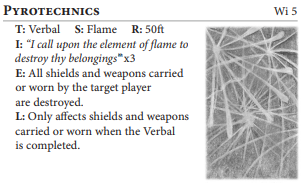
If you actually read the note on Pyrotechnics, this one is depressingly obvious. Unlike Heat/Shatter Weapon, Pyrotechnics doesn’t target a piece of equipment, it targets a player. You counter it by dropping the gear on the ground as the Wizard finishes casting. Pyrotechnics resolves, and the equipment you’re currently wearing or carrying is destroyed, which in this instance is nothing. Bonus points if you can time this in a way that you’ve dropped your equipment as the spell resolved, and picked it up again without it hitting the ground. Odds are good your strap shield may be gone, but statistically speaking if you have a strap shield, odds are good you also have a way to repair it in your kit (Sorry Barbarian players. And I guess Paladin and Antipaladin players) and hey! Who cares! The enemy Wizard just burned a 5th level spell that he at best has 4 of to make you drop your equipment and MAYBE blow up your shield. Now, to be fair. This is definitely inconvenient in a larger scale fight if your target is focused on somebody else, but there’s plenty of other things that are useful in a vacuum that are also useful when somebody is otherwise focused on somebody else.

So yeah, in short. Pyrotechnics doesn’t work if your target drops the stuff you’re trying to blow up. Use it as a bait for a spellball or to give a comrade an opening. Or in a big enough battlegame where your target wont notice. Oh yeah, and for the record even though it technically targets a player, it’s still affecting their equipment so Pyrotechnics does go through Enlightened Soul and Immunity to Flame.

Image result for mtg quicken art

Wizard Myth #3 – Swift Spell At a Range of Touch or “How I Learned to Stop Worrying and Love the Swift Shatter”

How often is it that you see some of your friends pushing in on an overtextending Druid, and you hear these cursed words.

“I take the form of stone!”

Probably a lot, right? I know that it is definitely a thing here in Blackspire. Stoneform is a staple of the Avatar of Nature build, despite being a verbal. It’s rechargeable, and allows an overextending Druid a bit of respite before coming out of it to murder you, most likely after your teammates have stopped paying attention to them because a lot of people seem to struggle with object permanence. Now, typically as a Wizard, your job in this situation is to gather around the Druid and start trying to Shatter them in order to force them out of the Stoneform so your friends can kill them. But, what if I told you that there’s a way to wield the awe inspiring power of Wizard in such a way as to utterly destroy the hopes and dreams of this hypothetical Druid. You need only approach the Druid, set a hand on them, and say the magic words

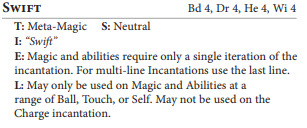
Swift. My power shatters thy body.”

And you know, have a Swift metamagic and a Shatter available.

Now some Druids know what’s going to happen, and will likely release themselves when you approach. But in many circumstances, you just landed a kill on someone who in all likelyhood is utterly stacked with enchantments, good job. Others are going to be really angry and confused, so we’re going to sit and calmly explain to the tree man how a real spellcaster takes care of business.

This is the Swift metamagic. And it’s good. It’s real good. It’s probably a bit too good but we’re going to set that aside. Now you may notice that this metamagic only appears to work on spells with a range of Ball, Touch, or Self. So you can (and totally should) Swift a Teleport on either yourself or another player to get out of sticky situations, Swift a Spellball for a quick follow through after you cast another spell, but you can also Swift any verbal when casting it at a range of touch. Tuck that away as we pull up another rule.

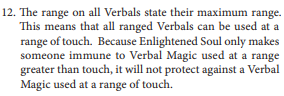
Page 73, Common Misconceptions 12

The listed range for a given verbal is its MAXIMUM range, meaning any verbal that is 20′ range can also be used at a range of touch. Therefore, you can Swift the Shatter! Hurray! This also means you could hypothetically Finger of Death yourself, or Icy Blast, or literally any of your offensive spells. Why you would ever want to do this as a Wizard, I wouldn’t know. You should also note that in the rare case of a Monk being frozen, their Enlightened Soul prevents them from being Shattered at a range other than Touch. So if you want to kill the pesky Monk your friend froze, you’re going to have to get up close.

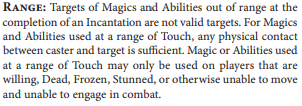
Page 55, Range

Now before you go and use this knowledge to perform evil, there are few uh, provisos, a couple of quid pro quos you should know about.

Rule Number 1: This really doesn’t work on enemy players who are Insubstantial. Please do not be that guy. I’ve been grabbed by my tunic before while trying to teleport away and Swift Released, and it was not a pleasant experience in addition to being unsafe. Insubstantial players can still technically resist if they’re in an Insubstantial state where they’re still capable of moving (Teleport, Blink, Gift of Air, etc). Feel free to Swift Release that Shadowstepped Assassin though, since he can’t move, and he can’t fight, he is considered willing.

Rule Number 2: You can Swift Release a willing player that is moving if they’re affected by something like Lost. So if you see your friend going back to base, you can step in his way, reach out, and so long as he keeps moving and you’re fast enough, you can Swift Release him out.

Rule Number 3: That’s really it, I just wanted to make an Aladdin reference.

Image result for chulane mtg art

Wizard Myth #4 – CHARGE

Oh man. Experienced and Charge are such confusing abilities. This one’s mostly for the newer/lower level Wizards, and people who are new to casters in general. I think the rulebook does a horrible job of explaining how this works, so I’m going to try to do it simpler or at the very least add a bit more nuance and have some examples. Knowing me I probably won’t, but here goes.

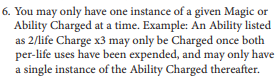
Spells that have Charge in their frequency, right after whether or not they’re a per life or per refresh, can be recharged. For 2 points of magic at 1st level, you can make up to two different spells level 4 and below rechargeable, either Charge x5 for a per life spell like Teleport, or Charge x10 for a per refresh spell like Icy Blast. You perform a recharge by saying the charge incantation a number of times equal to the spells recharge number. So a spell that is 1/life Charge x3 needs to recite the incantation 3 times, whereas 1/refresh Charge x10 requires you to say it 10 times. You also need to specify what it is you’re charging at the start, and while you don’t have to according to the rules, it’s considered a good practice to announce what you just charged after you finish. You also can’t move your feet, need an open hand, and it isn’t affected by metamagic. The charge incantation is as follows.

[Spell Name]

“Out of battle I pause to rest,
I take some time to catch my breath.
Return to me my fleeting power
To aid me in my darkest hour.”

It’s typically a good idea from here to shout loud as you can what you just recharged, just so the Reeves know whats up. I can’t find anything in the rules that declare this mandatory, but it’s good procedure.

Man, don’t you just love that? It’s a decent length, and it RHYMES. I wish more incantations rhymed. Anyway, you can only recharge an ability once all purchased uses of it have been used up. So if you buy 3 Shatters, go Shatter 3 people before you start Shattering people again. Also, per refresh abilities that you charged carry over if you die, but per lifes don’t. Basically you can’t cheat the system and go into a refresh or a respawn with a charged spell to give you an extra on top of the ones you have purchased.

Some more things. A lot of people get confused by this line and think that you can only have one spell charged at a time. So they (wrongly) believe that if you have say, Icy Blast charged, you can’t recharge Shatter. If there’s one thing for you to take away from this section, it’s that this is false. Here’s what the section says.

Page 48, Charge, Section 6.

So people read “one instance of a given magic charged at a time” and take it super literally. What this is trying to say is that if you have a rechargeable ability with a frequency of 2/refresh or 2/life, you need to use up both uses of the spell before you can recharge it again. So if you have Ravage Experienced to be 2/life Charge x5, you need to use both Ravages before recharging.

Lastly, there’s the Innate metamagic, and the spells Steal Life Essence and Confidence. These three abilities are basically what’s going to ensure that a higher level Wizard is pretty much never going to have to hard charge a Charge x10 past level 6. Innate is a per refresh ability that allows you to instantly recharge an ability when used.

Innate works by stating the spell name after using the metamagic, so proper usage is “Innate, Dispel Magic”. Boom. Dispel Magic is recharged. Like all metamagics, if you fail to complete what comes next, it’s used and does nothing.

Steal Life Essence works by touching a dead player (Either a friend or an enemy) and saying “Steal Life, [Ability] Recharged”. That ability is now charged, and the player is now Cursed. This ability doesn’t work on those who are already Cursed. Also, if for some reason the person you’re SLEing is Immune to Death, you still gain the effect, making a dead Paladin the ultimate power source.

Image result for powerstone art mtg

To nitpick other people on a mistake I used to make, the incantation is not actually “Steal Life Essence, [Ability] Recharged.” Steal Life Essence is a per life ability that you can take 2 of, 4 if you’re a Warlock. It’s also awesome. Being able to charge things and curse people this quickly is wonderful. Any list with hard hitting verbals that are rechargeable should take this spell.

Lastly, Confidence works by a Bard touching you and saying “My power grants thee confidence.” Then you shout “[Ability] recharged!” Or at least, that is best practice. Don’t be that guy, let everybody know where and how you’re getting your magic back. And make sure to contact your Bard if Confidence™ lasts for more than 4 hours.

And that’s Charge/Experienced/3 other spells that work alongside it! That probably not the absolute simplest way to explain it to somebody, but I hope it’s a bit more of a nuanced explanation than what’s in the rulebook.

Hot Take Tangent

I’m going to nitpick some more experienced casters. So if you don’t want to hear my opinion, feel free to skip this section. Cool? Cool.

Enunciate your charge incantation. This goes for all classes. I hear so many people try to charge so quick you sound like:

“Outofbattleipursetorushitksomethimetocatchmybreathretruntomemyflheetinpowertohadimeinmydurkhusthr”

Image result for larp he is speaking the language of the gods
Dead meme, I know

Charge, like other things that tend to take a hot minute to get off, is really good. It gives you more resources to play with and allows for a lot of your high impact spells to always be available. So the least you can do is do it properly. I get it, mid battlegame everyone is wheezing because we’re nerds with bad cardio and we’re full of adrenaline and the like, but this is a thing that you can do in the backline after calming down a little. I also get that speed is king while you’re casting, and its even better to get your resources back faster, but just like any other incantation people need to understand you otherwise it’s not valid. Also, you need to do it loud enough for a reeve to be able to tell that you’re recharging something. Just like with other long spells, especially those who affect friendlies, the risk of messing up the spell and having to start over outweigh the benefits so please, just take the extra few seconds to do your charge properly.

Conclusion

I hope that clears up a few things about Wizard. I’m sure there’s another half dozen weird interactions or misconceptions I could point out, but I’ll have to save something for when I feel like writing another one of these. Hopefully that won’t be too long from now, but you never know. Until then, this is Rook Silas Whitehallow, Man At Arms, signing off.

The Babbling Rook #2 – Spellball Wizard

Spellballs are arguably one of the most versatile tools in a Wizard’s arsenal. They offer a more sustainable method of dispatching the enemy team than per refresh verbal spells and allow you to respond faster to an incoming threat than most verbals. This isn’t to say they are the be all end all of the class, though judging by its design Wizard certainly can be viewed as the “spellball class”. Each spellball has its strengths and weaknesses however, and it’s important to remember which classes flat out possess an immunity to your magic. With that, I’ll start moving down the list by level, explaining each spellball and what situation its good in.

Forcebolt:  The first spellball available to wizards. While not as flashy as the other balls on this list, I argue that any list that runs spellballs should not forgo Forcebolts. For a single point of magic at first level, you get three spellballs which can be charged faster than any spellball in the game, as the incantation is just “Forcebolt” three times (Unique to this spell only). On a hit, it will either deal one wound to a valid hit location, destroy a weapon struck, or do one armor breaking hit to any armor it comes into contact with. Now in a lot of instances, I argue that armor breaking and weapon destroying aren’t that good, but in a few circumstances it can be downright devastating, such as destroying someone’s polearm, or the weapon of another caster in a one on one battle. There’s also not much more annoying than forcing a class that doesn’t have access to Mend (Mind you, only 5 classes don’t, two of which are exclusive to knights) to have to run to a teammate to repair their weapon. The armor breaking aspect of Forcebolt isn’t necessarily that useful, as a lot of your more heavily armored opponents will likely be running around in Ancestral Armor. That being said, destroying a Barbarian, Scout, or Bard’s armor in a line fight may free up an opportunity for a teammate to score a kill.  The most use I personally see out of Forcebolt is as a low cost, low risk ball to punish people who aren’t aware of their surroundings. Monks can negate spellballs by blocking with their weapons or an open hand, but if they’re in the middle of a line fight and aren’t enchanted, a Forcebolt to the chest is an easy kill if they’re not paying attention. A fun thing to do with Forcebolts is use them to destroy a Monk’s weapon(s) while they’re in Sanctuary so they have to run to a teammate for a Mend or another weapon. All and all a reliable spellball with a low cost for good value.

Suppression Bolt: I think a lot of people sleep on Suppression Bolt as a spell, and I can’t really blame them. It’s a subdual spell, which a lot of things have/can be given immunity to, and it’s effect doesn’t effectively stun/murder people. However, I tend to take a Suppression Bolt whenever I can because it effectively stops one of your opponents from playing a class game for 60 whole seconds. And it’s engulfing!  So that Dervish Bard or enemy Wizard who’s been giving you grief most of the game? You can shut them up and open a window for either you or your team to kill them. Furthermore, like Break Concentration (Which is another must take on any list that allows it) Suppression Bolt has some serious applications as a clutch spell that stops an enemy from getting back up from a Healer, or prevents one of your allies from getting stunned or killed. Word of warning though, it doesn’t actually stop Bard’s from continuing to chant, or prevent enchantment abilities from being activated.

Image result for mtg art entangle

Entangle: I would argue that Entangle is one of the weaker early level spellballs, especially since we Wizards get an upgrade to it later on. It’s subdual, so Barbarians are immune to it, and it causes an engulfing stopped effect, so you hit the person, their weapon(s), their garb, or their shield, and they’re unable to move their feet but can still act freely.  During this window, you should probably be trying to keep anyone with a Release off your victim and either handle them yourself, or call for a hand. Or run! Stopping someone without a Release in the middle of the battlefield or a ways away from the objective is just as good as legging them and running, if not better. At lower levels, it’s harder to follow through on a stopped opponent, but not impossible. Heat Weapon and Forcebolts become your friends, as you can stay at a safe range and get rid of their weapon(s). When stopped, you should also check to see if your victim has an enchantment worth dispeling, and take it as an easy opportunity to do so. Entangle also helps fuel your first two spell kill combo at earlier levels, so I suggest newer wizards take it, as well as anyone running an evoker build. Otherwise, maybe consider dumping some higher level points into…

Iceball:  Iceball is good.  It’s plain good. Yes it’s still subdual, but the frozen state is arguably better than killing people in a lot of situations. For one point of magic at level three you get TWO of these suckers that when thrown are an engulfing frozen effect.  Frozen, as you may know prevents your opponent from moving, acting, speaking (other than declaring their states and counting down), and combos wonderfully with a spell at level 4 called Shatter. It also lasts for 60 seconds, like all spellball effects, and sometimes (But let’s be honest, it’s most of the time) freezing someone for 60 seconds is just as good as killing them. Good spell, just don’t get too cocky with the engulfing effect as it is perfectly valid for someone to drop their shield perpendicular to the ground to block the spellball. As soon as they drop their shield, it’s considered a terrain effect and the spellball discharges without any effect. So yeah, beware that.

Image result for mtg lightning bolt

Lightning Bolt: Lightning Bolt is Wizard’s exclusive, better version of Entangle. It’s flame school, meaning it’s much harder to get immunity to, it still has its engulfing stopped effect for 60 whole seconds. However, since Wizard is awesome, our upgraded Entangle also destroys weapons, breaks (Non-Ancestral) armor, and causes a wound if you hit a valid location. This ball is simple and good, and you should consider running one or two to deal with Barbarians. Fun fact, if you kill a Barbarian while they’re stopped by this, they remain stopped if they activate Fight After Death.

Reduce to Ashes - Shadows over Innistrad Art

Fireball: Level 4 is a really good level for Wizards. You gain access to the Swift metamagic, allowing you to Swift-Teleport away from any bad situation (More on why Teleport is great in a future post), Suppress Aura as a RANGE 50’ SUPPRESSION VERBAL which lasts for 30 seconds. Icy Blast and Shatter are spells I suggest pretty much every Wizard takes Experienced the second they gain access to both spells for bigger fights as it’s a truly ridiculous two spell kill combo that you can continue to leverage as you hit higher levels with spells like Steal Life Essence or getting Confidence from a Bard. Dimensional Rift is a kill spell that works on Insubstantial, allowing you to make Assassins and people Teleporting feel bad about their life decisions, and while I’m personally not so hot on Wounding and Destroy Armor I recognize their value in some lists (Such as running a Warlock list). Fireball is still consistent though, giving you a chance to destroy a shield, a weapon, some armor, or a person. It’s another flame school spellball, meaning not many people are immune to it and there’s something viscerally satisfying about hucking a wounds kill projectile at someone, so I’d definitely say that this spell is pretty integral to Wizard’s class fantasy. That being said, I think if you’ve freshly hit level 4, consider taking some of the other really cool spells available at this level, such as Icy Blast/Shatter or D-Rift.  Fireball offers the consistency that other spellballs do, but it can also be blocked by as little as one measly point of armor, and I don’t view its ability to destroy weapons and shields as particularly relevant due to the fact that pretty much everybody either has a Mend, has an ability that functions like a Mend, or has a friend who has a Mend. That being said, remember that destroyed strap shields count as a valid hit location, so feel free to use Fireball to make an opening for either an ally, or yourself by Swifting another spellball or by casting sword. On an unarmored opponent though, maybe consider just using Forcebolt? If you beam them in the chest, it’s still a kill and you’re not down one of your more powerful spellballs. Speaking of powerful spellballs…

Image result for mtg dack fayden
I struggled to find an image of Phasebolt, so enjoy a picture of the greatest thief in the multiverse throwing magic.

Phase Bolt:  I love Phase Bolt, to the point where it’s usually the “default” spellball I carry around in my hand charged. It ignores any and all enchantments, including those granted as traits. Phase Bolt is an important, must take spell for anyone looking to not get creamed in the Wizard vs. Monk matchup, as it ignores their Magic Ball Block and Sanctuary abilities. You can also take Heat Weapon, but I personally hate that spell and believe that Phase Bolt has far more applications, is easier to cast, and has fewer counterplay options. It also ignores Ancestral Armor, allowing you to conveniently pop any unarmored player with an Ironskin, Stoneskin, or Barkskin, and you can hypothetically use it to soften up a AA Warrior’s armor thanks to the fact that it’s armor breaking (Though there’s a better spellball available for this). It also doesn’t procc Gift of Air, making it invaluable in a Wizard vs Wizard showdown where your opponent has said very annoying enchantment.  All and all, this is a solid choice that should be ran in most lists that can take it.

Sphere of Annihilation: Say it with me kids. Sphere. Is. Hype. For the high cost of two points of sixth level magic, you get Finger of Death on a Stick™.  It ignores armor (And by extension Ancestral Armor), ignores enchantments, destroys weapons, destroys shields, destroys hopes, destroys dreams, and kills any player hit, leaving them cursed and forcing some poor enemy Healer to Greater Release and Rez or Greater Resurrect your victim. One of the amazing things about Sphere that you ought to know is that thanks to its wording, specifically that “A player hit is killed” so long as you’re technically hitting them, even if it’s not a valid location for a wound they’re dead and cursed, do not pass GO, do not collect 200$. Furthermore, abilities and enchantments that might save your victim, such as Blessing Against Wounds which work on lesser spellballs such as Fireball because it prevents the wound that is Wounds Kill don’t function against awesome power that is Sphere. Just as icing on the cake however, a Warrior cannot True Grit after being killed with a Sphere of Annihilation, similar to how if you’re fast enough, Steal Life Essence is capable of denying them the same ability through inflicting the Cursed state. Barbarians killed with a Sphere of Annihilation can still Fight After Death, but hey, you can’t win them all, plus a well built Wizard will carry at least a couple other answers for Barbarians. Another thing to add is that while the price seems steep, most of Wizard’s bread and butter spells are actually at 4th and 5th level.  So, you’re probably going to find yourself only taking maybe 4 points of magic at the highest level, and that’s usually only if you’ve taken on an archetype. In summary, Sphere is awesome and you should run it the second you get it, unless you’re super keen on playing battlemage.

And that’s spellballs! Technically speaking there is also Abeyance, but I’m rating Wizard spellballs here. In conclusion, your spellballs are your workhorses, they’re consistent and are capable of both killing players, holding objectives, and making space for your team. Pretty much every ball has its use, and you should try to include a couple of them in every list you run, unless you’re running Battlemage.

Challenge Question Answer:

Q: A Warrior with 5 points of Ancestral Armor and enchanted with Golem is frozen with an Icy Blast. While frozen, can you cast Dispel Magic at them?

A: Yes, though the frozen state specifically says that the person can only be affected by spells and abilities that affect states in general or the frozen state in specific, Dispel Magic specifically states that it works on individuals who are frozen or insubstantial, so dispel away.

Challenge Question: If you throw a Phase Bolt at someone with Blessing Against Wounds and hit their arm, do they take a wound?

The Babbling Rook #1 – Archetypes and You

Hi there, welcome to The Babbling Rook, where I, Rook Whitehallow, talk about Wizard Things™. This week, we’re going to talk about spell selection, specifically Archetypes and their trade offs. This article was originally entered into the Blackspire Spire Article Writing Competition, but since the Spire has taken a hot second to publish it and I’m anxious to write this column on a close to bi-weekly schedule, I’ll be self publishing The Babbling Rook moving forward. I’ve tried to keep the original styling of the entry intact, though I’ve opted to make it a little less flurby and cut down on the flowery language.

Now you, dear reader, may now be asking yourself “Rook, I know what spells/archetype I should be taking, X is what I’m comfortable with and what I’m best at.” and send me your perfect spell list, which is perfect in every situation and never fails, and to that I would say that while Wizard is incredibly varied in its spell arsenal, the perfect spell list does not exist. Though I am immensely fond of a generalist, master-of-none playstyle (Of which you will hear me excitedly espouse the virtues of in some future segment, or whenever prompted in person) your spell selection and archetypes should vary heavily depending on the battle game, it’s objectives, how many players you are opposing, and your team’s composition. One of the wonderful things about playing Wizard is we can hypothetically field answers to pretty much anything.

As an example, a Battlemage utilizing experienced Icy Blast and Shatter as their primary kill engine may be very effective in smaller battle games with fewer people, especially if they take plenty of Innates and Steal Life Essences to consistently get their Icy Blasts and Shatters back. However, such a strategy falls apart in longer more grueling battles of attrition, as even with the help of a Bard their power is very much finite. Conversely, an Evoker finds themselves equipped to deal with longer battles of attrition, but may find themselves struggling against Ancestral Armor, as all but two of our spell balls are negated by it and the Evoker sacrifices many of the Wizard’s most powerful utilities including Dispel Magic and Break Concentration. Warlocks can serve as tempting middle ground, with the increased uses of verbals from the Death and Flame schools giving you more resources to spend while sporting a reliable kill combo, however it still carries with it a few of the same problems as Evoker, little flexibility and utility. Warlocks are barred from many of the same spells as Evoker, including practically all of the spells that come in handy when things turn south and you find yourself overrun such as Teleport or Astral Intervention.

In summary, as a Wizard one of your greatest strengths is your ability to adapt towards any team composition or battle game type. You should try to read the situation and select your spells accordingly. With that, I’ll leave you all with a challenge question, which will be answered in the next column.

Challenge Question: A Warrior with 5 points of Ancestral Armor and enchanted with Golem is frozen with an Icy Blast. While frozen, can you cast Dispel Magic at them?