
Well, that’s just typical isn’t it? I start up on a project I really like, write a couple entries, and then ditch it completely in the following months. So for the three of you who actually read and enjoy this kind of thing, you have my apologies for not keeping up with any kind of release schedule.
That being said, as anyone who has spoken with me at any sort of Amtgard event may know, I still have thoughts about Wizard! Thoughts that I doubt will be going away anytime soon, so I suppose I’ll keep writing them down every now and again for people to read and maybe enjoy.

So, that being said. I want to discuss the top misconceptions I see people have about Wizard, why they may have them, and dispel them. So without further ado…
Wizard Myth #1 – Heat Weapon/Weapon Identifiers
This is less a misconception, but something that is often overlooked because it’s pretty unintuitive and makes casting this spell harder. This will likely come up again later when I go over spells that I personally think are overrated, but I’d like to draw people’s attention to this little part of the rule book.

This rule is pure jank, and makes the two spells that affect a specific piece of equipment (Namely Heat/Shatter Weapon) a lot harder to get off since in addition to all the traditional counter play your opponent has (For example, hiding their weapon. Since you’re targeting the weapon, line of sight rules apply) you have to spend more time than usual getting off the identifier before doing the incantation proper. I see a lot of new wizards being advised to run around with a shortsword and a bunch of Heat Weapons, expecting to just be able to heat their opponent’s weapon (of which they only have one in this dream scenario) and kill them with their sword. That’s a whole other rant though, for the time being just know that if it targets a specific piece of equipment, you need to call out which piece of equipment you’re attempting to use the spell on. Another note, these spells do still work if the equipment is not being worn by a player, so you can heat a shortsword on the ground to prevent someone from picking it up and using it, or chain heat an already heated weapon to prevent someone from picking it up as it gets closer to timing out.

Wizard Myth #2 – Pyrotechnics
Leading into this section here, I want to let everybody know a hot take of mine. I know, this is supposed to be a more objective article, but I just can’t hold this in.
Ready? Okay.
Verbals that destroy or disable the use of certain pieces of equipment aren’t very good.
I mean honestly. Between the previous myth that we went over, and this bit here about Pyrotechnics, I’m really not so hot (Ha) on this suite of spells. They’re trickier than the average verbal to cast, and ultimately their usage is niche and easily countered. You can Greater Release a heated weapon. Or, you know, just be carrying multiple weapons. I’ll go into this deeper on my “overrated spells” article if I ever get around to it. That being said, want to know how to counter a 5th level spell?
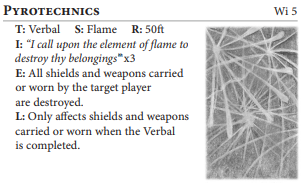
If you actually read the note on Pyrotechnics, this one is depressingly obvious. Unlike Heat/Shatter Weapon, Pyrotechnics doesn’t target a piece of equipment, it targets a player. You counter it by dropping the gear on the ground as the Wizard finishes casting. Pyrotechnics resolves, and the equipment you’re currently wearing or carrying is destroyed, which in this instance is nothing. Bonus points if you can time this in a way that you’ve dropped your equipment as the spell resolved, and picked it up again without it hitting the ground. Odds are good your strap shield may be gone, but statistically speaking if you have a strap shield, odds are good you also have a way to repair it in your kit (Sorry Barbarian players. And I guess Paladin and Antipaladin players) and hey! Who cares! The enemy Wizard just burned a 5th level spell that he at best has 4 of to make you drop your equipment and MAYBE blow up your shield. Now, to be fair. This is definitely inconvenient in a larger scale fight if your target is focused on somebody else, but there’s plenty of other things that are useful in a vacuum that are also useful when somebody is otherwise focused on somebody else.
So yeah, in short. Pyrotechnics doesn’t work if your target drops the stuff you’re trying to blow up. Use it as a bait for a spellball or to give a comrade an opening. Or in a big enough battlegame where your target wont notice. Oh yeah, and for the record even though it technically targets a player, it’s still affecting their equipment so Pyrotechnics does go through Enlightened Soul and Immunity to Flame.

Wizard Myth #3 – Swift Spell At a Range of Touch or “How I Learned to Stop Worrying and Love the Swift Shatter”
How often is it that you see some of your friends pushing in on an overtextending Druid, and you hear these cursed words.
“I take the form of stone!”
Probably a lot, right? I know that it is definitely a thing here in Blackspire. Stoneform is a staple of the Avatar of Nature build, despite being a verbal. It’s rechargeable, and allows an overextending Druid a bit of respite before coming out of it to murder you, most likely after your teammates have stopped paying attention to them because a lot of people seem to struggle with object permanence. Now, typically as a Wizard, your job in this situation is to gather around the Druid and start trying to Shatter them in order to force them out of the Stoneform so your friends can kill them. But, what if I told you that there’s a way to wield the awe inspiring power of Wizard in such a way as to utterly destroy the hopes and dreams of this hypothetical Druid. You need only approach the Druid, set a hand on them, and say the magic words
“Swift. My power shatters thy body.”
And you know, have a Swift metamagic and a Shatter available.
Now some Druids know what’s going to happen, and will likely release themselves when you approach. But in many circumstances, you just landed a kill on someone who in all likelyhood is utterly stacked with enchantments, good job. Others are going to be really angry and confused, so we’re going to sit and calmly explain to the tree man how a real spellcaster takes care of business.
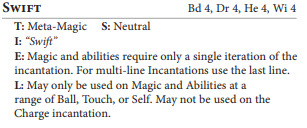
This is the Swift metamagic. And it’s good. It’s real good. It’s probably a bit too good but we’re going to set that aside. Now you may notice that this metamagic only appears to work on spells with a range of Ball, Touch, or Self. So you can (and totally should) Swift a Teleport on either yourself or another player to get out of sticky situations, Swift a Spellball for a quick follow through after you cast another spell, but you can also Swift any verbal when casting it at a range of touch. Tuck that away as we pull up another rule.
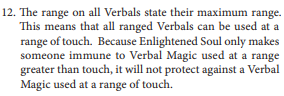
The listed range for a given verbal is its MAXIMUM range, meaning any verbal that is 20′ range can also be used at a range of touch. Therefore, you can Swift the Shatter! Hurray! This also means you could hypothetically Finger of Death yourself, or Icy Blast, or literally any of your offensive spells. Why you would ever want to do this as a Wizard, I wouldn’t know. You should also note that in the rare case of a Monk being frozen, their Enlightened Soul prevents them from being Shattered at a range other than Touch. So if you want to kill the pesky Monk your friend froze, you’re going to have to get up close.
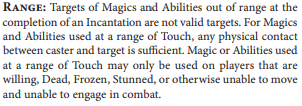
Now before you go and use this knowledge to perform evil, there are few uh, provisos, a couple of quid pro quos you should know about.
Rule Number 1: This really doesn’t work on enemy players who are Insubstantial. Please do not be that guy. I’ve been grabbed by my tunic before while trying to teleport away and Swift Released, and it was not a pleasant experience in addition to being unsafe. Insubstantial players can still technically resist if they’re in an Insubstantial state where they’re still capable of moving (Teleport, Blink, Gift of Air, etc). Feel free to Swift Release that Shadowstepped Assassin though, since he can’t move, and he can’t fight, he is considered willing.
Rule Number 2: You can Swift Release a willing player that is moving if they’re affected by something like Lost. So if you see your friend going back to base, you can step in his way, reach out, and so long as he keeps moving and you’re fast enough, you can Swift Release him out.
Rule Number 3: That’s really it, I just wanted to make an Aladdin reference.

Wizard Myth #4 – CHARGE
Oh man. Experienced and Charge are such confusing abilities. This one’s mostly for the newer/lower level Wizards, and people who are new to casters in general. I think the rulebook does a horrible job of explaining how this works, so I’m going to try to do it simpler or at the very least add a bit more nuance and have some examples. Knowing me I probably won’t, but here goes.
Spells that have Charge in their frequency, right after whether or not they’re a per life or per refresh, can be recharged. For 2 points of magic at 1st level, you can make up to two different spells level 4 and below rechargeable, either Charge x5 for a per life spell like Teleport, or Charge x10 for a per refresh spell like Icy Blast. You perform a recharge by saying the charge incantation a number of times equal to the spells recharge number. So a spell that is 1/life Charge x3 needs to recite the incantation 3 times, whereas 1/refresh Charge x10 requires you to say it 10 times. You also need to specify what it is you’re charging at the start, and while you don’t have to according to the rules, it’s considered a good practice to announce what you just charged after you finish. You also can’t move your feet, need an open hand, and it isn’t affected by metamagic. The charge incantation is as follows.
“[Spell Name]“
“Out of battle I pause to rest,
I take some time to catch my breath.
Return to me my fleeting power
To aid me in my darkest hour.”
It’s typically a good idea from here to shout loud as you can what you just recharged, just so the Reeves know whats up. I can’t find anything in the rules that declare this mandatory, but it’s good procedure.
Man, don’t you just love that? It’s a decent length, and it RHYMES. I wish more incantations rhymed. Anyway, you can only recharge an ability once all purchased uses of it have been used up. So if you buy 3 Shatters, go Shatter 3 people before you start Shattering people again. Also, per refresh abilities that you charged carry over if you die, but per lifes don’t. Basically you can’t cheat the system and go into a refresh or a respawn with a charged spell to give you an extra on top of the ones you have purchased.
Some more things. A lot of people get confused by this line and think that you can only have one spell charged at a time. So they (wrongly) believe that if you have say, Icy Blast charged, you can’t recharge Shatter. If there’s one thing for you to take away from this section, it’s that this is false. Here’s what the section says.
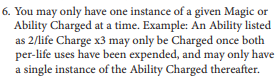
So people read “one instance of a given magic charged at a time” and take it super literally. What this is trying to say is that if you have a rechargeable ability with a frequency of 2/refresh or 2/life, you need to use up both uses of the spell before you can recharge it again. So if you have Ravage Experienced to be 2/life Charge x5, you need to use both Ravages before recharging.
Lastly, there’s the Innate metamagic, and the spells Steal Life Essence and Confidence. These three abilities are basically what’s going to ensure that a higher level Wizard is pretty much never going to have to hard charge a Charge x10 past level 6. Innate is a per refresh ability that allows you to instantly recharge an ability when used.
Innate works by stating the spell name after using the metamagic, so proper usage is “Innate, Dispel Magic”. Boom. Dispel Magic is recharged. Like all metamagics, if you fail to complete what comes next, it’s used and does nothing.
Steal Life Essence works by touching a dead player (Either a friend or an enemy) and saying “Steal Life, [Ability] Recharged”. That ability is now charged, and the player is now Cursed. This ability doesn’t work on those who are already Cursed. Also, if for some reason the person you’re SLEing is Immune to Death, you still gain the effect, making a dead Paladin the ultimate power source.
To nitpick other people on a mistake I used to make, the incantation is not actually “Steal Life Essence, [Ability] Recharged.” Steal Life Essence is a per life ability that you can take 2 of, 4 if you’re a Warlock. It’s also awesome. Being able to charge things and curse people this quickly is wonderful. Any list with hard hitting verbals that are rechargeable should take this spell.
Lastly, Confidence works by a Bard touching you and saying “My power grants thee confidence.” Then you shout “[Ability] recharged!” Or at least, that is best practice. Don’t be that guy, let everybody know where and how you’re getting your magic back. And make sure to contact your Bard if Confidence™ lasts for more than 4 hours.
And that’s Charge/Experienced/3 other spells that work alongside it! That probably not the absolute simplest way to explain it to somebody, but I hope it’s a bit more of a nuanced explanation than what’s in the rulebook.
Hot Take Tangent
I’m going to nitpick some more experienced casters. So if you don’t want to hear my opinion, feel free to skip this section. Cool? Cool.
Enunciate your charge incantation. This goes for all classes. I hear so many people try to charge so quick you sound like:
“Outofbattleipursetorushitksomethimetocatchmybreathretruntomemyflheetinpowertohadimeinmydurkhusthr”

Charge, like other things that tend to take a hot minute to get off, is really good. It gives you more resources to play with and allows for a lot of your high impact spells to always be available. So the least you can do is do it properly. I get it, mid battlegame everyone is wheezing because we’re nerds with bad cardio and we’re full of adrenaline and the like, but this is a thing that you can do in the backline after calming down a little. I also get that speed is king while you’re casting, and its even better to get your resources back faster, but just like any other incantation people need to understand you otherwise it’s not valid. Also, you need to do it loud enough for a reeve to be able to tell that you’re recharging something. Just like with other long spells, especially those who affect friendlies, the risk of messing up the spell and having to start over outweigh the benefits so please, just take the extra few seconds to do your charge properly.
Conclusion
I hope that clears up a few things about Wizard. I’m sure there’s another half dozen weird interactions or misconceptions I could point out, but I’ll have to save something for when I feel like writing another one of these. Hopefully that won’t be too long from now, but you never know. Until then, this is Rook Silas Whitehallow, Man At Arms, signing off.


 The Babbling Rook